
Python Programming: The Complete Guide to Mastering Python in 2026
 Introduction:
Why Python Continues to Dominate?
In the ever-evolving landscape of technology, one programming language has consistently remained at the forefront: Python. As we move through 2026, Python’s popularity shows no signs of waning. Its simplicity, versatility, and powerful ecosystem make it the go-to choice for beginners and experts alike. From web development and data science to artificial intelligence and automation, Python powers some of the most innovative solutions across industries.
This guide is designed to take you on a journey through Python programming, starting from the absolute fundamentals and progressing to advanced professional concepts. Whether you’re a complete beginner or an experienced developer looking to deepen your knowledge, you’ll find valuable insights that will help you master Python and apply it effectively in real-world projects.
Part 1: Python Fundamentals – Building a Strong Foundation
What Makes Python Unique?
Python was created with a philosophy that emphasizes code readability and simplicity. Its syntax is clean and intuitive, often resembling plain English. This makes it an ideal first language for beginners while remaining powerful enough for experts. Python is dynamically typed, meaning you don’t need to declare variable types explicitly, and it supports multiple programming paradigms including procedural, object-oriented, and functional programming.
Setting Up Your Python Environment
Before writing your first Python program, you need to set up a proper development environment. Installing Python from the official website is straightforward, but professional developers also rely on virtual environments to manage project dependencies. Tools like venv or conda allow you to create isolated spaces for each project, preventing conflicts between different versions of libraries.
Core Concepts You Must Master
Variables and Data Types: Python supports various data types including integers, floating-point numbers, strings, and booleans. Understanding how to work with these types is fundamental.
Data Structures: Python’s built-in data structures – lists, tuples, dictionaries, and sets – are incredibly versatile. Lists are ordered and mutable, tuples are immutable, dictionaries store key-value pairs, and sets ensure uniqueness.
Control Flow: Conditional statements like if, elif, and else let you control program execution based on conditions. Loops such as for and while enable repeated execution of code blocks.
Functions: Functions are reusable blocks of code that perform specific tasks. Python allows you to define functions with default arguments, keyword arguments, and even anonymous lambda functions.
Comprehensions: Pythonic way to create lists, dictionaries, and sets concisely. They make your code more readable and efficient.
Why These Basics Matter
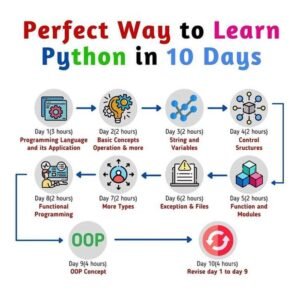
Mastering the fundamentals is crucial because every advanced concept builds upon them. Without a solid grasp of data types, control flow, and functions, you’ll struggle with more complex topics. Take time to practice these basics through small projects and exercises.
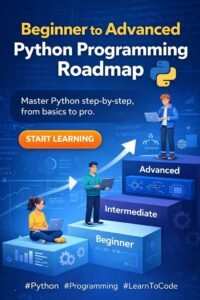
Part 2: Intermediate Python – Taking Your Skills to the Next Level
Object-Oriented Programming (OOP)
Object-oriented programming is a paradigm that organizes code into objects containing data and methods. Python supports OOP with classes and inheritance. Key concepts include encapsulation (bundling data and methods), inheritance (creating hierarchies), and polymorphism (using a unified interface). OOP is essential for building large, maintainable applications.
Error and Exception Handling
Professional code must handle errors gracefully. Python’s try, except, else, and finally blocks allow you to catch and manage exceptions. You can also raise custom exceptions to signal error conditions in your own code.
Working with Files and Data
Reading from and writing to files is a common task. Python’s file handling is simple and safe when using the with statement. Additionally, working with popular data formats like CSV and JSON is straightforward thanks to built-in modules.
Modules and Packages
As projects grow, organizing code becomes critical. Python modules are simply .py files that can be imported. Packages are directories containing multiple modules and an __init__.py file. The Python Standard Library offers a vast collection of modules for everything from system operations to web services.
Understanding Scope and Namespaces
Scope determines where a variable is accessible. Python has local, enclosing, global, and built-in scopes. Understanding scope helps you avoid bugs and write cleaner code.
Part 3: Advanced Python – Achieving Professional Mastery
Advanced OOP Concepts
Metaclasses and descriptors are advanced features that allow you to customize class behavior. While you may not use them daily, understanding them gives you deeper insight into how Python works and enables you to use frameworks more effectively.
Decorators and Closures
Decorators are a powerful tool for modifying or enhancing functions without changing their source code. They are widely used in web frameworks for routing, authentication, and logging. Closures, which capture variables from enclosing scopes, are the foundation of decorators.
Concurrency and Parallelism
Modern applications often need to perform multiple tasks simultaneously. Python offers threading for I/O-bound operations, multiprocessing for CPU-bound tasks, and asynchronous programming with asyncio for high-performance I/O. Each approach has its strengths and trade-offs.
Testing and Code Quality
Professional development relies on testing. Unit testing frameworks like unittest and pytest help you verify that your code works as expected. Test-driven development (TDD) is a discipline where you write tests before code. Code linting and formatting tools ensure consistency and catch errors early.
Performance Optimization
When your application needs to run faster, profiling tools like cProfile help identify bottlenecks. Optimization strategies include choosing efficient data structures, using built-in functions, caching results, and even writing performance-critical parts in C.
Design Patterns in Python
Design patterns are reusable solutions to common problems. Python implements patterns like Singleton, Factory, and Observer in idiomatic ways. Knowing these patterns helps you design robust, scalable systems.
Part 4: Real-World Applications of Python
Web Development
Python excels in web development with frameworks like Django, Flask, and FastAPI. Django is a full-featured framework for building complex applications quickly. Flask is lightweight and flexible, ideal for microservices. FastAPI is modern and fast, with automatic API documentation.
Data Science and Machine Learning
Python is the undisputed king of data science. Libraries like NumPy, Pandas, and Matplotlib enable data manipulation and visualization. Scikit-learn provides machine learning algorithms, while TensorFlow and PyTorch power deep learning. Data scientists use Python to analyze data, build models, and derive insights.
Artificial Intelligence
AI development relies heavily on Python. From natural language processing with spaCy and NLTK to computer vision with OpenCV, Python offers tools for every AI domain. Large language models and generative AI are also built using Python frameworks.
Automation and Scripting
Python is perfect for automating repetitive tasks. System administrators use it to manage servers, developers use it for build scripts, and marketers use it for SEO automation. Python can interact with APIs, manipulate files, and control browsers.
SEO Automation with Python
Digital marketers and SEO professionals increasingly rely on Python to gain a competitive edge. Python can automate keyword research, analyze search console data, perform technical SEO audits, and optimize content. This saves countless hours and provides deeper insights than manual methods.
Keyword Research Automation: Python scripts can scrape search results, analyze keyword difficulty, and identify long-tail opportunities.
Technical SEO Audits: Python can crawl websites, check meta tags, analyze site structure, and generate comprehensive reports.
Search Console Analysis: Using Google’s APIs, Python can fetch performance data and identify trends.
Content Optimization: Natural language processing libraries help analyze content for keyword density, readability, and semantic relevance.
Part 5: Python Career Paths and Opportunities
Why Python Skills Are in High Demand
Python developers are sought after across industries. The language’s versatility means you can work in web development, data science, AI, automation, and more. Companies value Python for its productivity and the vast ecosystem of libraries.
Top Python Job Roles
Data Scientist: Analyze complex data, build predictive models, and communicate insights. Average salary exceeds $120,000.
Machine Learning Engineer: Develop and deploy machine learning systems. Salaries often top $135,000.
Backend Developer: Build server-side logic using Django, Flask, or FastAPI. Demand remains high.
DevOps Engineer: Automate infrastructure and deployment using Python scripts.
SEO Automation Specialist: A niche but growing role combining marketing and programming skills.
AI Engineer: Work with cutting-edge AI technologies including large language models.
Certifications and Learning Paths
Certifications from the Python Institute, Google, AWS, and Meta validate your skills. However, practical experience through projects is equally important. Contributing to open source, building a portfolio, and networking with other developers accelerate your career growth.
Part 6: Tips for Mastering Python in 2026
Learn by Doing
Theory alone won’t make you a proficient programmer. Build projects that interest you – a personal website, a data analysis dashboard, an automation tool. Each project teaches you something new.
Stay Updated
Python’s ecosystem evolves rapidly. Follow blogs, attend conferences, and participate in online communities. Keep an eye on new libraries and best practices.
Write Clean Code
Readable code is maintainable code. Follow PEP 8 style guidelines, use meaningful variable names, and document your functions. Your future self will thank you.
Embrace Collaboration
Programming is often a team effort. Learn to use version control systems like Git, participate in code reviews, and contribute to open source. Collaboration improves your skills and expands your network.
Specialize Wisely
While knowing Python broadly is valuable, specializing in a domain like data science, web development, or AI can make you more marketable. Choose a path that aligns with your interests and career goals.
Conclusion: Your Python Journey Starts Today
Python is more than just a programming language – it’s a gateway to endless possibilities. Whether you want to build websites, analyze data, create AI systems, or automate tasks, Python gives you the tools to succeed. This guide has provided a roadmap from fundamentals to advanced concepts, but the real learning begins when you start coding.
The demand for Python skills continues to grow in 2026 and beyond. By investing time in mastering Python, you’re investing in your future. Start with the basics, practice consistently, and gradually tackle more complex projects. Soon, you’ll be writing elegant, efficient code that solves real problems.
Remember, every expert was once a beginner. The journey of a thousand miles begins with a single step – or in this case, a single line of Python code. So open your editor, write that first print("Hello, World!"), and embark on an exciting adventure into the world of Python programming.